The Ultimate Science-Backed Guide to Building Better Habits and Breaking Bad Ones

The Huberman Lad Podcast with James Clear  |  January 21, 2026

In our daily lives, we are constantly solving recurring problems. You finish a long, exhausting day of work—how do you unwind? One person might go for a run, another might play video games, and another might smoke a cigarette. These are all habits—automatic, learned solutions to the recurring problems and cues in our environment. But what if the solutions you inherited aren’t the best ones for you? According to James Clear, author of the monumental bestseller Atomic Habits, and Stanford neurobiology professor Andrew Huberman, the moment you realize your habits may not be serving you is the moment you take responsibility for designing a better system for your life. This powerful shift from passive inheritance to active design is the foundation of lasting behavioral change.

This comprehensive guide synthesizes their profound conversation, merging the neuroscience of behavior change with practical, real-world strategies. Whether you want to start exercising, write a book, be kinder, or break a stubborn bad habit, the insights here will provide you with a science-based toolkit for transformation. We will explore the core principles that make habits stick, the critical role of identity and environment, and provide actionable steps you can implement immediately to reshape your daily routines and, ultimately, your life outcomes.

Sticky notes that say bread old habits, build good habits on top of a desk

What Are Habits, Really? A Neuroscientific Perspective

Habits are more than just routines; they are deeply learned behaviors that become automatically tied to specific contexts and cues. From a neurological standpoint, building a habit is a process of self-directed adaptive neuroplasticity—your brain physically rewiring itself through deliberate, repeated practice. James Clear offers a powerful and practical definition: “Habits are solutions to the recurring problems in our environment.” By the time you’re an adult, many of your habitual solutions were unconsciously inherited from parents, friends, or your early environment. The journey to better habits begins with auditing these automated responses and asking: “Is this the best possible solution for me, or merely the one I learned first?” This audit is the first step toward conscious behavior design.

The Four Laws of Behavior Change: A Complete Framework

Clear’s entire framework for building good habits and breaking bad ones is built on four core, research-backed principles. To build a lasting, positive habit, you must make it:

  1. Obvious (Easy to notice and initiate)
  2. Attractive (Appealing and enjoyable to perform)
  3. Easy (Frictionless and simple to execute)
  4. Satisfying (Providing immediate reward or pleasure)

Conversely, to break a bad habit, you strategically invert the four laws:

  1. Make it Invisible (Hide the cues and triggers)
  2. Make it Unattractive (Reframe it negatively in your mind)
  3. Make it Difficult (Increase the steps and friction required)
  4. Make it Unsatisfying (Add an immediate cost or consequence)

The genius of this system is its immense flexibility. You don’t need to use all four laws at once for every habit. The more levers you pull strategically in your favor, however, the more likely you are to succeed and the faster the new neural pathways will form. This framework moves beyond vague motivation and into the realm of actionable engineering.

The Four Laws of Behavior Change - A Practical Application Guide

To BUILD a Good Habit:To BREAK a Bad Habit:Practical Application Example (Writing Habit)
1. Make it Obvious1. Make it InvisiblePlace your notebook and pen in the exact center of your desk each morning. Unsubscribe from all distracting promo emails and news alerts that disrupt focus.
2. Make it Attractive2. Make it UnattractivePair your writing session with a great cup of coffee or a special playlist. Reflect deeply on how social media scrolling drains your creative energy and delays your goals.
3. Make it Easy3. Make it DifficultCommit to writing just one sentence to overcome the initial barrier. Delete all social media and game apps from your phone, requiring a desktop login for access.
4. Make it Satisfying4. Make it UnsatisfyingTrack your word count in a satisfying journal or app with visual progress bars. Create a “habit contract” where you must pay a friend $50 if you skip your writing two days in a row.

The #1 Secret to Habit Success: Master the Art of Starting

The single biggest lesson from millions of habit journeys is the undeniable, critical importance of the starting ritual. “Mastering that five-minute window—or sometimes even that 30-second window—of choosing to start is the single biggest theme of habits,” Clear explains. This initial friction point is where most battles are won or lost before they truly begin, making it the most important leverage point in your entire behavioral system.

Most habit problems logically boil down to two categories: procrastination (can’t start) or inconsistency (can’t stick with it). But sticking with it almost always just means you successfully started each time. Therefore, the ultimate key to long-term consistency is mastering the deceptively simple art of getting started. By optimizing for the start, you build momentum that carries you through the rest of the activity, turning a daunting task into an automatic behavior.

Practical Tips to Make Starting Effortless:

  • Radically Scale Down the Habit: Dream of a 45-minute workout? Start with just putting on your workout shoes and walking out the door. James shares a powerful story of a reader named Mitch who built an unshakable gym habit by only allowing himself to stay for five minutes. He masterfully focused on the habit of showing up, and the full workouts naturally and effortlessly grew from that solid foundation.
  • Priming Your Physical Environment: Intentionally walk through your living spaces and ask: “What behaviors does this current environment make obvious and easy?” To run in the morning, sleep in your running clothes. To play guitar more, leave it on a stand in the middle of the living room where you’ll see it, not hidden in a closet under a pile of old boxes.
  • Use the Powerful Strategy of Habit Stacking: Tie your new, desired habit directly onto an existing, strong habit you already have. Use the formula: “After I [CURRENT HABIT], I will [NEW HABIT].” For example, “After I pour my morning coffee, I will immediately write one sentence in my project document.”

Key Takeaway: The heaviest weight at the gym is the front door. Your primary goal is to reduce the mental and physical friction to starting, and you will win more than half the battle. By conquering the start, you make the entire habit inevitable.

Identity: The Deepest Layer of Lasting Change

While traditional goal-setting focuses narrowly on what you want to achieve, identity-based habits focus profoundly on who you wish to become. This subtle but monumental shift is a true game-changer for building sustainable, internal motivation that doesn’t rely on fleeting willpower or external rewards.

Every single action you take is a small but meaningful vote for the type of person you wish to become. Writing for 20 minutes is a vote for being a disciplined writer. Choosing a healthy snack is a vote for being a conscientious, healthy person. These votes are small individually, but they accumulate into a powerful electoral victory for your desired self-image over time. “The healthiest version of me just flowing with it is asking, ‘What do I feel like I’m encoded to do?'” Clear describes. Over consistent time, you cross an invisible psychological threshold where your core self-image fundamentally shifts. You don’t run because you have a race; you run because you are a runner. The motivation becomes internal, identity-driven, and incredibly durable, making the habit resilient to bad days and low energy.

Consistency Over Perfection: The Power of the “Bad Day” Protocol

One of the most liberating insights for long-term success is that healthy, sustainable habits can and should have seasons. Your workout routine, writing schedule, or creative practice must adapt to the different, demanding chapters of your life. The rigid, relentless pursuit of a mythical “perfect” habit execution is often the primary enemy of a good, consistent one that actually lasts for years.

Instead of asking the idealistic question, “What could I do on my absolute best day?” ask a more resilient and practical question: “What is the absolute minimum I could stick to even on my very worst, most chaotic day?” This establishes a baseline that is virtually unbreakable.

  • The Bad Day Workout: Can’t face your full 60-minute routine? Do just one set of squats and call it a victory. A focused 20-minute session counts infinitely more than a demoralizing zero.
  • The Bad Day Writing Session: Feeling completely uninspired? Commit to writing just one meaningful sentence. Just open the document and add a single line of text to maintain the chain.
  • The Revolutionary Two-Minute Rule: Scale any ambitious habit down to a two-minute starting version solely to maintain the crucial behavioral rhythm. “Read before bed” becomes “read one single page.”

“True consistency is actually intelligent adaptability,” Clear states. “Don’t have enough time? Do the brilliantly short version. Don’t have enough energy? Do the incredibly easy version. Your sole mission is to find a way to show up and not put up a zero for that day.” This philosophy directly fights the destructive “all-or-nothing” mindset that derails so many people. The sheer consistency of showing up, even in a cleverly diminished form, progressively enlarges your ability over time and builds the resilient mental toughness that all high performance is built upon.

The Habit Flexibility Spectrum: Mindset in Action

Situation“All-or-Nothing” MindsetAdaptive & Consistent Mindset
Exhausted after work“I’m too tired for my 1-hour workout. I’ll skip it entirely today.”“I’ll do the 15-minute home bodyweight routine. Something is always better than nothing for momentum.”
Behind on a big project“I don’t have 3 free hours to write, so I won’t start at all.”“I’ll write for 25 minutes right now. That’s tangible progress and builds momentum.”
Traveling or On Vacation“My entire routine is completely broken. I’ll get back on track next week.”“What’s the one core habit (e.g., 5 mins of meditation) I can do daily to maintain the thread?”
Missed a day entirely“I’ve ruined my perfect streak. I might as well give up entirely.”Embrace the “Never miss twice” rule. I missed Monday, but I will absolutely make sure I get back to it on Tuesday without fail.

The Critical Role of Environment and Social Gravity

Your environment acts as a relentless, invisible form of behavioral gravity, constantly nudging you subtly toward certain actions and away from others. You are not just passively building habits; you must become an active architect building an environment that makes those desired habits inevitable and your bad habits nearly impossible. This is a fundamental principle of modern behavior design.

  • Physical Environment: If potato chips are on the kitchen counter, you’ll eventually eat them. If a bowl of fruit or nuts is on the counter, you’ll eat those instead. Make the visual and physical cues of your good habits blatantly obvious and the cues of your bad habits completely invisible.
  • Digital Environment: Your smartphone is a potent context-blending machine, merging work, social media, games, and communication into one addictive device. Create intentional friction: leave your phone in another room while you do deep work, delete social media apps and only use them on a desktop, or turn off all non-essential notifications to regain control.
  • Social Environment: This is perhaps the most powerful and underrated force. “We are incredibly, deeply social creatures. The primal desire to belong and connect will often powerfully override the conscious desire to improve,” Clear explains. You must strategically join groups where your desired behavior is simply the normal, expected behavior. If that specific group doesn’t exist in your life, you have the agency to create it, as Clear did by forming mastermind groups with fellow authors.

Advanced Insights: From Neuroscience to Real-World Application

The Effort as the Reward

Both Huberman and Clear discuss the pinnacle of habit development: the stage where the effort itself becomes the intrinsic reward. This neurological shift doesn’t happen overnight but emerges after sustained practice. After years of training, Clear notes he now works out for the focused feeling of the set itself, not just the long-term physique outcome. This is the ultimate payoff where the habit loop becomes self-sustaining and intrinsically satisfying, independent of external results.

Your Inputs Dictate Your Outputs

A crucial insight for creators, learners, and anyone seeking growth: “Almost every thought you have is directly downstream from the media and information you consciously consume.” Your daily reading, podcasts, and who you follow on social media are effectively choosing your future thoughts and creative ideas. To have better, more creative and productive outputs, you must ruthlessly curate higher-quality, relevant inputs. Clear describes his ideal creative day: workout first (to change physical and mental state), then reading (to fill the intellectual tank), then writing (to drive and create). The high-quality reading strategically primes the brain for effective, inspired writing.

The Transformative Power of Strategic Reflection

Huberman highlights the proven neuroscience of learning: deliberate reflection and active self-testing dramatically increase retention and mastery. This applies perfectly to habit formation. Clear practices this with his children by reviewing the positive parts of their day, and he personally does a weekly 30-minute business review with no agenda other than to think strategically. This intentional “reset” space is where you can climb above the daily grind to assess if you’re working on the right things, not just working hard on busywork. It’s a meta-habit that compounds all other efforts.

Breaking Bad Habits: The Strategic Inversion Strategy

Let’s apply the inverted Four Laws to a common, stubborn bad habit: late-night snacking on unhealthy junk food.

  1. Make it Invisible: Simply do not buy the junk food at the grocery store. If it’s not physically in your house, you cannot eat it impulsively at night.
  2. Make it Unattractive: Actively associate the habit with immediate negative outcomes. Visually remind yourself how the sugar crash makes you feel lethargic, bloated, and ruins your sleep quality.
  3. Make it Difficult: If you must have treats in the house, store them in an highly inconvenient place (e.g., the freezer in the detached garage). Dramatically increase the number of steps and effort between your impulse and the behavior.
  4. Make it Unsatisfying: Create a binding habit contract. Agree with a partner that if you indulge, you must immediately do an undesirable chore (like cleaning the bathroom) or make an automatic donation to a cause you dislike.

Final Takeaways: Your Immediate Action Plan

  1. Start Exceedingly Small, Start Today: Focus ruthlessly on reducing the friction to starting. Make the very first step so laughably easy you simply cannot rationalize saying no to it.
  2. Intentionally Design Your Environment: Become the architect of your spaces. Make good habits the blatantly obvious path of least resistance and bad habits inconvenient and invisible.
  3. Cast Votes for Your Future Identity: Continuously ask “Who do I want to become?” and let your small, consistent daily actions be deliberate votes for that person, building evidence for your new self.
  4. Embrace Intelligent Adaptability: Seek relentless consistency, not mythical perfection. Allow your habits to have seasons and adapt to life’s changes. Remember, a “bad day” workout is more important than a “good day” workout.
  5. Ruthlessly Curate Your Inputs: Your mind is permanently shaped by what you feed it. Consciously choose high-quality information to fuel the high-quality habits and thoughts you desire.
  6. Adopt the “Never Miss Twice” Rule: Slip-ups are an inevitable part of the human process. The real key to long-term success is not flawless execution, but a quick, non-judgmental rebound to get back on track immediately.

Building better habits isn’t about relying on sheer, fleeting willpower; it’s about intelligently building a smarter, self-reinforcing system around you. It’s the applied science of strategically stacking small advantages and proactively designing a life where the right things become easy, obvious, and inherently satisfying. As James Clear concludes, the moment of true personal power arrives with the realization: “My current solutions may not be the best possible solutions. It’s now my active responsibility to figure out and design a better way.” That better, more intentional way starts with your very next small action.

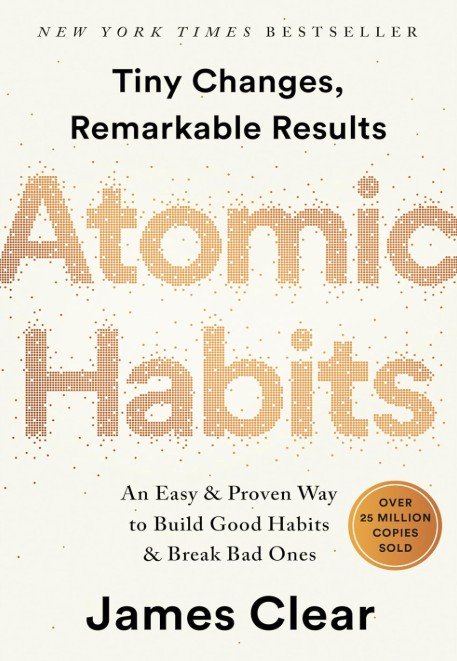
Atomic Habits Book Cover

Atomic Habits: An Easy & Proven Way to Build Good Habits & Break Bad Ones

Master the science of lasting change with Atomic Habits—James Clear’s proven framework turns small, daily actions into remarkable results. Get your copy today and start building a system that makes success automatic.

*Podomline may earn a small commission if you buy through these links—at no extra cost to you. Thank you

Related Post

Leave a Comment

Your email address will not be published. Required fields are marked *